Archive for the ‘Spring Cleaning’ Category

7 Ways To Be More Organized at Home and Feel Good Again

Posted by

Make organizing a little easier

Most people want to be organized but rarely do we want to put in the effort to get organized.

If you are feeling stuck – and who doesn’t feel stuck sometimes when it comes to making positive changes — It’s important to remember why you want to be organized?  In other words, what do you want to achieve or feel when you’re done?

Don’t think about it as “I wish I had less clutter,” which is a negative motivation. Instead think about it as “I’d have more space,” or “I’d have more control over my surroundings or I’d feel more peace-of-mind.

Here are 7 ways you can start developing an organizing habit

  1. Daily Maintenance Rituals: Take ten-minutes (set a timer if you wish) to tidy up a space. Focus on frequently used spaces like your kitchen counters, bathroom sink area or desktop.
  2. Declutter First, Organize Second: Sort and purge what you don’t want. Contain only what you keep.  No sense buying furniture, bins or containers for things you’re not keeping.
  3. Use Clear Storage Bins:  Closed cabinets, garages and pantries are perfect spots for labeled, clear containers. Use similar sizes and types to keep the space looking uncluttered and make it easy to find what you need.
  4. Maximize Vertical Space: Utilize wall hooks, higher shelves, and over-the-door organizers to keep floors and surfaces clear. 
  5. Shop Your Home: Use containers or bins you already have for organization before buying new ones.
  6. Command Centers: Create a dedicated space near your entry/exit doors for mail, keys and things that need to be mailed or returned.
  7. Donation Bag in the Closet: Keep a grocery size shopping bag in your closet to make getting rid of unneeded clothing items effortless.

Does one of these resonate with you? My personal favorite is #2 but I actually did #7 today. Being organized is about developing new behaviors that bring you closer to a better version of yourself.  If your home or space were as organized as you imagine, what would you be able to do that you can’t do now? How would that make you feel?

Need a way to get help for your organizing challenges? Schedule a complimentary discovery call with me or visit, LET’S MAKE ROOM

How Lis Helped Me Declutter My Dishes in 90 Minutes

Posted by

Editor’s Note: Cara Lanz is a freelance writer, digital marketer, and self-proclaimed word nerd. She is also a god-send to me.  This month she is my guest blogger. When she isn’t creating digital content for clients across the country, she is blogging on MidwesternHomeLife, her own lifestyle website. She loves to share simple and (sometimes) healthy recipes, debt-free tips, and inspiration for creating a happy home in the heartland. You can find Cara at https://midwesternhomelife.com/. 

I knew I needed to declutter my dishes when it came down to a math problem I just couldn’t solve. I had two people in the house and a dinnerware cabinet brimming with — among other things — 21 dinner plates, 12 salad plates, 17 saucers, and 20 soup bowls. 

Now, in my defense, they were all matching– well, as matching as Fiestaware can be — and neatly organized. No haphazard piles or plastic containers shoved in there. So, on its face, it didn’t really appear as though I needed to declutter my dishes. 

But the math just didn’t work. Plus, I had other cabinets bursting at the seams with things I wanted to move into my dinnerware cabinet. 

How would I go about deciding what to keep and what to get rid of? 

Enter Lis McKinley, owner of LET’S MAKE ROOM. As an organizational expert, she’s helped hundreds of others figure this very thing out. 

But, I wondered: Would she finally be the one to pry my superfluous Fiestaware from my gripped fingers, or would I be the one and only person she has not been able to help? I really had no idea which way this was going to go. 

So we set up a Zoom meeting. 

My Virtual Organizing Call with Lis

When I first got on a call with Lis, I noticed two things right away. She’s warm and welcoming and made every crazy organizational dilemma I had seem like it was totally normal, and she’s heard it a million times. She’s also extremely decisive in that teacher kind of way that just made me want to do what she said because I knew she knew what she was talking about. 

She laid out our plan for exactly what we were going to do during our time together. She even had a clever acronym for her process: S.P.A.C.E. She gently took the time to explain what each of the steps meant and made sure I understood them. 

For the next hour, we: 

Sorted

Purged

Assigned

Contained

Equalized

Here’s what that looked like. 

Sort

To get started, I pulled all my dishes out of the cabinet and put them into like piles. Bowls with bowls, plates with plates. Not only did this help me to see with clarity exactly what I was dealing with, but it also gave me an empty cabinet, aka, a clean slate, to start all over again. 

Purge

The goal of purging was to make decisions about which items I wanted to keep, based on four criteria: Do I love them, want them, need them, or use them? We had really thoughtful conversations and she asked me things like, “If you saw that in a store, would you buy it again?” We also discussed how often we entertain, how many adults and kids, and which dishes we need to accommodate them. Then we pared down from there. It all made perfect sense. 

We also sifted through things that I knew just weren’t going to go back into the cupboard. These super fussy 2-part martini chiller/chilled appetizer glasses, for example. Also, some heirloom dishes that are pretty enough, but I’m just not using them. 

Assign

During the assign process, I had to find a home for everything. To figure that out, I had to think about where I would most likely look for things if I needed to use them. So a good amount of my dinnerware was assigned back to the cupboard. 

Those fussy 2-part glasses — and other things I’ll never use again — went straight into the “Donate” box. The heirloom dishes went into my “Ask Mom If She Wants Them Back” box. But that wasn’t the end of it. Lis made me pick a date when I would drop off the “Donate” items and send a pic to my mom of the items that were potentially going to boomerang back to her. So, now I was accountable. But, it was all on a timeline that I chose. 

Contain

Now it was time to put things back. Contain my pared-down dishes into the cupboard. But it wasn’t just, “Okay now put everything back.” Lis asked me to think about each item I was putting back and where it would be best to put it. We had discussions about things like, “Well, we really use these bowls more than those bowls,” and “I can’t reach those plates very well when the dishwasher is open.” So it was super strategic, and I could tell it was going to set me up for long-term success. 

Also, Lis knew one of my goals was to get rid of so much stuff in this cupboard that I could free up my entire top shelf, drop it down to a level I could actually reach, and transport items I use all the time from another hard-to-reach cupboard. So while Lis sat in the Zoom room, I hauled over a bar stool, climbed up on my counter, and dropped down that top shelf. Just like that, that cupboard became 33.33% more useful to me!

Equalize

During the equalize phase — this was the tidying up at the end of it all — I easily put things back where they belonged. Lis explained that the process of assigning and containing is what makes it possible to equalize, because I had already established a home for everything. 

I had a pile of plates and bowls that were going to be put away into my pantry for when I needed them for a large party. I had certain dishes I only use for my food blog that needed to go where those things live. At last, everything was where it should be. 

My Dishes, Decluttered

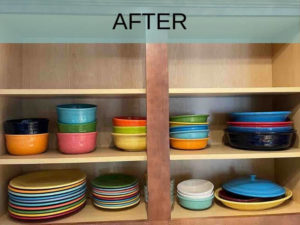
By the end of our hour and a half together, my cupboard was whittled down to a svelte 10 dinner plates, 10 salad plates, and 10 soup bowls. Zero saucers. Lots of room for everything we need, in the places that make the most sense. AND a completely empty shelf ready to take on the overflow when I use the S.P.A.C.E. method to clear out my next cupboard. 

Organize your clothes-closet painlessly during a pandemic

Posted by

It’s called the reverse hanger technique. Here’s how it works:

Turn all your hanging clothing around so each hanger faces towards the back of your closet. As you wear items, return them to face the front of the closet. Now mark your calendar for 6 months from the date you did this. On that day, notice which clothing items are still facing towards the back.  These are the ones you haven’t worn!

I recently did this after emptying all my hanging clothes from my closet so my husband could paint it. As I put things back, I noticed right away a few things I didn’t want so they went right into the donation bag. The rest were hung on my favorite space-saving hangers with the hook turned towards me. The last few days I have been putting items back with the hooks turned away from me.  I know there will be items that may not get turned around but this gives me confirmation and then I can decide in six months whether it still makes sense to keep them.

Woman-organizing-clothes-in-closet

Still energized to do more?

  1. Create a simple plan such as: Sell what I can sell. Give special items to special people I know. Donate the rest.
  2. Sell high-quality, designer brand clothes online through sites like the RealReal.com or your local consignment shop. Since the pandemic, many have launched online buying and selling sites.
  3. Donate usable quality clothing to a local thrift shop such as American Cancer Society Discovery Shops or Goodwill. Call to check before you go as some have limited hours during the pandemic.
  4. Never donate anything that is torn or stained. This is costly for charities to get rid of. These items should be tossed or recycled if possible. Check out the website Earth911.com for fabric recyclers in your area.

The Secret to Being Organized, Getting More Done and Finding Happiness

Posted by

Recently I learned about something called the Intention-Action Gap. The intention-action gap is a term used by people, mainly behavioral experts, who study the reasons why we do or don’t do things that are good for us.

In simple terms, the intention-action gap refers to the difference between what people say they would like / plan to do and what they actually do. For example, people say they want to get organized, or lose weight, or get more exercise or eat healthier but they don’t.

Behavioral experts explain this “gap” between our intentions and our actions in several ways but recently I came across an article written by Ozoda Muminova, a London-based researcher, business and organizational consultant who helped me understand this disconnect between what we want and what we actually do in a delightful and amusing way.

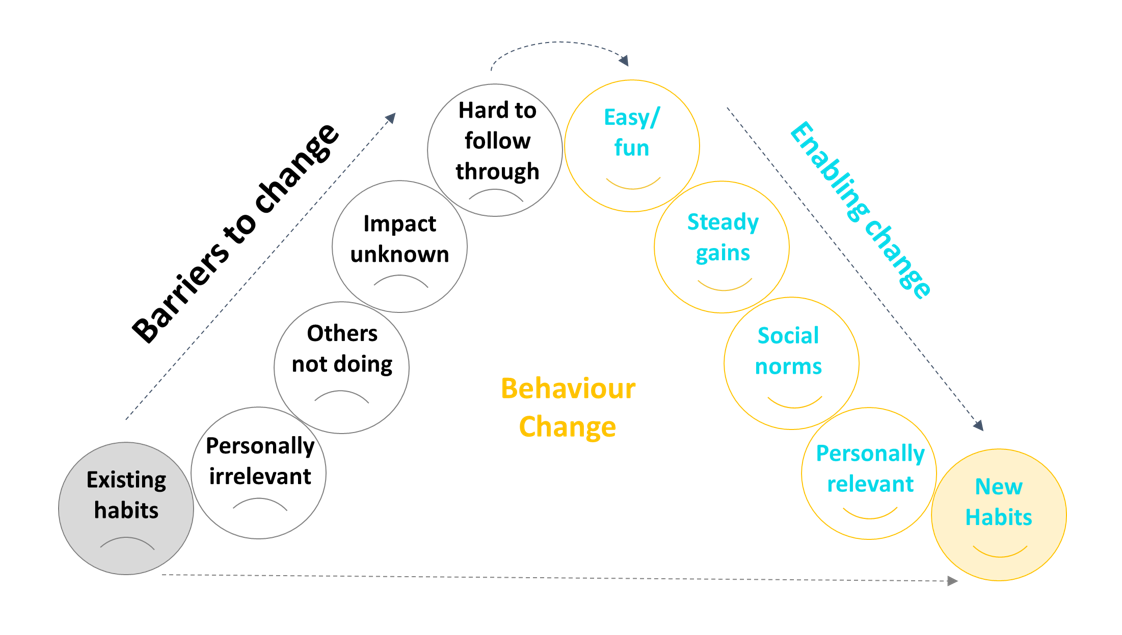
Basically she said that as humans there are certain barriers to changing our behaviors. Things like, habit, unknown impact, feeling isolated and overcoming difficulty.  Her answer, in short: make it fun, make it social, make it personal and make it immediately rewarding.

Ozoda created this simple model to explain how to meet every barrier to change, with an enabler of change:

5 steps for turning good intentions into good behaviours. Used by permission of The Good Insight/Ozoda Muminova


I got to thinking about this in the context of why so many of us, myself included, really want to achieve a certain goal like losing weight, exercising more and even getting organized, but can’t follow through.  You may start but within a moment you find yourself procrastinating or putting it off again.

Inspired by these ideas of challenging each barrier with a positive enabler, consider this simple 5 step approach to changing old habits that get in the way of your happiness.

For every barrier you have to your goal, whether it be losing weight, exercising more, getting more organized or something else, do what you can to make it fun, make it relevant to you personally, make it possible to see change immediately so you’ll keep going, make it social, that is, look for evidence that others are doing it too and make it rewarding!

Let’s say you want to organize your closet. Here’s an example of how you could apply this simple plan to get it done!

1. Make it fun

Play your favorite upbeat music or ask your best (most fun) friend to help you. Put on your most colorful and silly clothes to get you inspired or set up sturdy bins and practice your awesome basketball dunk or free throw for those items you are sending to donation. The point is, if you make it fun and easy you are more likely to get it done.

2. Make it personally relevant

Be clear about why you are getting organized, in other words ask yourself, what’s in it for me? Will you enjoy being able to see your newly organized closet? Will it make it easier for you to find what you need when you need it? Will it make you feel good about yourself and what you’ve accomplished? If you can equate the task to something meaningful to you – my discarded stuff could help others, getting dressed in the morning will be easy and fun, I will feel good about showing off my home to my friends – you are more likely to get it done.

3. Look for immediate change

Next consider a plan for how to see change immediately. I recommend breaking the task into smaller pieces . Instead of attacking the entire closet, start with just the top shelf or one side before tackling the rest. Psychologically, we are motivated to continue once we see small changes.  If you are tackling a larger space,  clear off a surface –  the floor or a table –  as you are more likely to continue when you see clear space versus something you can’t see such as a drawer. Remember you can only climb a flight of stairs, one or maybe two, steps at a time. The point is you’ll still get there.

4. Make it social

If you are unable to enlist the help of your family or friends (or if you don’t want to), consider that you are not alone in your desire to get organized. The popularity of people like Marie Kondo and The Container Store are evidence of the trend in organizing. Why not set up a challenge with an online friend or find a virtual room for other like-minded people to share your progress with on social media sites such as Facebook, Instagram, Pinterest or FlyLady.net. You could also arrange to have an “accountability” partner. This is someone you know who you can report your progress to with no judgement. I often do this for my clients.

5. Make it rewarding

Finishing an organizing project is its own reward. I know the satisfaction I feel when I complete a large organizing project for a client and sometimes I want to celebrate my accomplishment with my crew. We may go out for dinner or to a local tap room for a beer or I may just go home and take a luxurious hot, bubble bath.

The intention-action gap explains why we can’t overcome our resistance to change or existing habits. Understanding the 5 barriers to change and replacing them with these 5  “enablers” of change can turn bad habits into new behaviors that lead to a happier and more satisfied life.

I believe getting organized is about making room in your life for what you enjoy the most.  So now that you’re done, go do something just for you or do it with others so you can celebrate your success together!


The Ultimate Garage Organization Survival Guide

Posted by

Editor’s Note: In June we celebrate all things Dad, in celebration of Father’s Day. This month, I’m pleased to share this informative guide to garage organizing written by Trent Skousen, from Golden Gate Garage Storage, a colleague and associate member of the local chapter of my professional association, NAPO (National Association of Organizing and Productivity Professionals). Trent and I share a lot of the same ideas about garage organizing. Read on and make this Summer the one you finally get your garage organized!

When I was a kid, my mom would task the family with giant cleaning days. They were usually before family or friends came to visit, although I suspect some days, she just got the itch to clean up. We would spend all day sorting through the living room, bedrooms, and kitchen to make everything look nice and orderly.

Part of that organizing was removing the clutter from most of the house. Unfortunately, we just dumped most of that extra stuff in the garage. Have too many toys in the bedroom? Throw some in a box in the garage. Too many cleaning supplies under the bathroom sink? Put ‘em in the garage. We did that over and over.

As a result, the garage became so cluttered and packed over time, we couldn’t even park our cars in there. It became so cramped that we lost all motivation to get it organized. The whole project was overwhelming. Finally, my dad persuaded (bribed) my brother and me to take a week of our summer vacation to go in there and sort everything out.

Many homeowners experience something similar happening in their own garages. These spaces look more like an old warehouse than a functional home space. It becomes a dumping ground for everything we don’t want to deal with in the house. How do we end this vicious cycle? With a little conscious effort, an organized and functional garage isn’t as far-fetched as it sounds.

With Father’s Day around the corner, now is a great time to take a look at getting that garage fixed up for Dad. Here is your ultimate survival guide to get you started.

Step 1- Develop a game plan:

Benjamin Franklin said, “By failing to prepare, you are preparing to fail.” Planning in organization is just as important as doing the organizing itself. Not only does planning give you an idea of what you need to accomplish, it gives you the peace of mind of knowing what you need to do exactly when you need to do it.

Sit down with your team. This can be your family, friends, or organizing professionals. Set a realistic goal that you can shoot for. One example could be to leave nothing left on the garage floor by the time you finish.

After you have your goal, here are some tips about things to include in your plan:

  • Pick a date- You need to get a specific date in mind to start and stick to it. Write it out and tell your family. Make sure that you are set on getting to work and won’t have anything to distract you. Give yourself a reasonable amount of time to complete it. Don’t plan to finish it in a day if you need several weekends.
  • Plan on who will be helping- How many people will be there to help? How much can each person handle? Are there any children helping that need simpler jobs?
  • Figure out costs- If you’re planning on hiring help or buying equipment, you’ll need to set a budget and determine costs ahead of time. Be sure to weigh the cost against the benefit for each item – sometimes paying a little more will save you time, money, and stress in the long run.

Step 2- Cleaning:

Move all of the items in the garage out to the driveway, lawn, or backyard. You won’t be able to do a deep clean without emptying the space first. If you have limited space or weather issues, consider focusing on smaller portions of the garage at a time.

As you move your possessions, it helps to sort them into piles based on their function (i.e. camping gear, gardening equipment, power tools, etc.).

With the empty space, deep clean the garage surfaces, walls, and floors. Start from the ceiling and move toward the floor, so you don’t get things dirty that you already cleaned:

  • Replace any dead light bulbs.
  • Dust off shelves and cabinets.
  • Wipe down any tables or workbenches.
  • Scrub the walls and floorboards to remove scuff marks and blemishes.
  • Sweep and mop the floor.

Having a clean garage will not only make it look nicer, but also make it safer to breathe the air and touch the surfaces inside.

Step 3- Decluttering:

*Note: This step is interchangeable with Step 2. You can do this before, after, or during the cleaning phase. Do what is best for your situation.

Now, you’ll want to start getting rid of anything you don’t need in order to create more space.

Start by systematically going through everything individually. Like I mentioned, it helps to group things together by category (like chemicals, tools, stored personal items), and decide what you still need and what you don’t. If things are broken, old, or you don’t use them anymore, get rid of them first.

After that, take what remains and make a second pass at them. This can be trickier, because now you really have to think about the item and the likelihood you will use in the near future.  Like Lis McKinley, Certified Professional Organizer and owner of LET’S MAKE ROOM always says, “Just because something is useable, doesn’t mean you have to keep it! Almost everything is useable. When you need space, the goal should be looking for reasons to let it go, not finding reasons to keep it.”

If there are items of sentimental value, ask yourselves if you really are happier having it around or if you’ll use it. If not, it’s time to let it go.

Be realistic about what you keep in the garage,” she adds. “It should be things you actually use, such as tools, or things used seasonally such as sports equipment or holiday supplies – but even these things can be curated. Stick with the notion of, do I use it now? Am I likely to use it this year? Would I miss it if it disappeared? If not, give it away where it can be used and appreciated.

Step 4- Reorganize:

At this point, you should have your essential items and a clean garage. It’s time to organize your items in the garage.

Consider using a zoning strategy. Zoning means to group similar items together in storage. This helps you know where everything is and helps you keep track of what you have and makes it easier to find what you need in the future. If you already grouped items together during decluttering, this shouldn’t be too hard.

Another suggestion is to consider using storage systems. This can be as simple as stackable bins, hooks on the wall, and baskets. Other options that really reduce the clutter include shelves, cabinets, and overhead storage racks. Storage systems help get everything off the ground safely. This is especially useful if you have young kids wandering through the area, because you can keep dangerous chemicals or tools hidden out of reach. Plus, it gives you more space to park your car or even include things like workbenches or workout equipment.

Step 5- Continue the process:

Just because your garage is clean and organized doesn’t mean it will stay that way without help. Plan time each week to tidy up, just as you would with the rest of your house. Sweep out debris and make sure things are off the ground and in their proper place. If you buy something new that needs a place, take a few minutes to rearrange everything so that it has a proper place of its own.

Having a nice garage will make your home more functional and enjoyable. With a little planning, organizing can be a fun and rewarding process!

This post was written by Trent Skousen at Golden Gate Garage Storage. He enjoys going to movies and watching basketball with his wife.

Downsize your way to a stress-free move.

Posted by

Planning to move this Summer? Don’t pack a box until you read this.

Moving is the perfect opportunity to assess whether or not you need to downsize your home’s contents so that you don’t end up spending the time and money to move, insure and unpack items you don’t really want. There are so many great reasons to downsize. Here are some of my favorites:

  1. You’ll sell your old home faster. An uncluttered home is massively appealing to home buyers. Nowadays, real estate agents won’t even consider listing your home until it’s cleared of all your personal belongings.
  2. It’s safer. The less clutter on surfaces, stairs, floors or near electric or gas appliances, the better. So even if you’re not moving this alone is one great reason to downsize.
  3. You’re the one in charge! You get to decide what stays and what goes and if you give yourself enough time, you won’t be making those decisions under pressure.
  4. You can preserve memories. It’s easier to find the irreplaceable things in your life when you can easily find them.
  5. Less stress. You will feel the peace of mind that comes from living an uncluttered life, surrounded by the people and things you enjoy the most
  6. Save money. The less you move, the less it costs.

What to take, what to sell, what to donate

Not sure what you’ll take with you?  That’s okay, you probably have a lot you don’t want now. Start to downsize well before you move and you get to decide what goes — nobody pressuring you!  Best of all, you won’t make hasty decisions in the days leading up to your move that you may regret later.

If you have items you plan to sell such as good quality furniture, jewelry, luxury brand clothing or valuable artwork, you will first need to determine whether these items are in demand. Check out both local estate sellers and consignment services as well as online estate services that can consign or buy your items outright. One easy way to do this is to send them a few photos. It’s free and you’ll know pretty quickly what they may be worth.  One word of caution, don’t expect the value to equal what you paid for an item or what you “think” it’s worth.  If the item has value, they too will want to make a profit so they will never buy it for what it’s worth from an insurance standpoint.

Want to keep it simple and easy? In the San Francisco Bay Area there are services such as Remoovit.com that will literally take everything you don’t want and haul it away for one flat fee. Anything they can sell, they will and you will get fifty percent of the final sale price. Whatever can not be sold, will be donated or recycled. Remoovit once sold a rusty old “banana seat” bicycle belonging to one of my clients for $1,200. She got half of that which paid for the hauling of everything else!  You pay by the truck load (or fraction thereof). It’s a one-stop service for those who need their homes to be emptied quickly but don’t want to simply give away items that may have market value.

Where do I start?

Not sure where to start? Begin with whatever area of your home you’ve been wanting to tackle but just haven’t had a good enough reason. Now you do. You’re moving and you want to surround yourself with the things that you love and use most. This doesn’t mean everything else goes in the trash. On the contrary, it’s likely you have usable items that somebody else wants (any may even pay for!) including family, friends, neighbors and members of your community.

Set aside one area of your home where you will sort and label as you go. A dining room is a good place for this as it’s less likely you will be entertaining at home in the weeks leading up to your move. Otherwise, pick an area that you occupy less frequently such as a guest room.  Here are some other helpful tools you will need:

  • A folding table or work surface for sorting (if not in your dining room).
  • Supply of large, plastic yard bags for donating soft goods such as clothing, purses, accessories, good quality linens, outerwear. Keep in mind most charities will not accept bed pillows, bedding, or old linens. Old towels may be donated to local animal shelters.
  • Small moving or packing boxes, preferably ones with handles. Use these to donate home decor, small household items, kitchen tools and other hard-edged items.
  • Blue or green painter’s tape to label furniture, framed art work, lamps and other large items you no longer want.
  • A couple of black “sharpie” markers to use with the painter’s tape to label boxes, bags and unwanted items.
  • A glass or bottle of water (you’ll want to stay hydrated as you work!)

If you are lucky to have family nearby, especially strong children or grandchildren, ask them to load items in your car you wish to transport yourself or ask them to take them for you. Otherwise, you can count on the help of the charities that will pick up your items by truck.

Make a list of your preferred charities that accept household goods. Be sure they are available before you move. Many charities book 2-3 weeks in advance.

Don’t forget your local church bazaar, senior center and friends of the library. There may also be a veteran’s group in your area that will pick up your donated goods. Animal shelters and your local veterinarian are always in need of clean, old towels.  Women’s shelters can use your unused, unopened toiletries. (Think of all those unopened hotel shampoos and body lotions you’ve collected over the years.) Local hospice stores, or other charities that operate re-sell or “thrift” stores are a great way to donate.  Not sure where to donate clothing? Ask your local consignment store. They are usually a wealth of information. Lastly you will be grateful for the help of charities that do truck pick up. Not sure which ones serve your area? Do a Google search, “charities that do truck pick up near me.

Helpful Tips for Downsizing

  1. Start early. Don’t wait until a week before you move. Give yourself at least a month or more so you don’t have to make decisions under pressure.
  2. Focus on one room at a time. This way you will see progress and stay motivated.
  3. Don’t buy more!  Now is not the time time to go clothes shopping or re-stock your pantry. Use up what you have.
  4. Segregate your paper. Don’t attempt to “go through” your files until you’ve downsized your other household goods. Instead, contain all your paper files in banker boxes and use the days leading up to the move to determine what you need to keep.
  5. Use painters tape (not sticky notes – they fall off) to label items for donation
  6. Save your back. Use charities that offer truck pick up to take your boxed and bagged items as well as your donated furniture

When to ask for help

  • If you are feeling overwhelmed by the whole process and know you can’t do this alone or are worried you would be overwhelmed by the memories and emotions often associated with large-scale downsizing
  • If you are working full time or traveling a lot and know you could use some help to make the process go faster
  • If you are far away from family or friends and need help with the physical work of sorting and transporting items for you
  • If you have physical limitations or just don’t have the endurance to deal with it yourself.  This is especially true if you are clearing out large storage areas such as basements, garages and storage sheds.

Garage or junk drawer: Getting it organized is the same process.

Posted by

Whenever I meet with a new client I show them how we organize a large space by organizing a small space. This is because it’s the same process,  just on a smaller scale. Often I start with a junk drawer but no matter the size of the space, as long as you are organizing physical items (not paper) the process is the same.

  1. Gather the contents by emptying it onto a flat surface such as a table or bed.  Dust out the drawer if needed.
  2. Sort items by type, such as pens with pens, tools with tools, paper with paper. Don’t throw anything away until you are done. Just focus on sorting. This should take just a few minutes. Don’t skip this step. It’s the most important!
  3. Purge what you don’t use, need or love.  Start with obvious trash and move on from there. Usable items can be donated. Loose bits of paper can be reviewed and recycled or shredded as needed.
  4. Decide what belongs back in the junk drawer or somewhere else in your home.   Wait till you’re done before moving these items into other rooms, otherwise you’ll lose your momentum.
  5. Contain like items with small containers or a a drawer organizer.  This will make it easy to find and return items when you’re done using them.

It’s also important to start with the right tools such as bags or boxes for the items you no longer use, need or love. Want to see how it’s done?

Check out my video.

The best gifts to get the pack rat in your life

Posted by

The last thing that special person in your life needs, who also happens to be challenged by too much stuff, is more stuff.

Some people have too many useless or long forgotten objects to fill up a void in their lives, especially if they live alone. Others hold on to things to hold on to memories. There are also those who keep things for their potential use. Unfortunately these things rarely if ever get used. Fear of loss or pain is another reason people keep things they don’t really need.

Instead of buying one more thing, here’s a list of my favorite gifts for that special “collector” in your life. The best part of these gifts is they involve spending time with you! Because if you are reading this, you are probably pretty special too.

  1. A personalized gift certificate from you for a special experience or outing you could enjoy together.
  2. Gift card to their favorite restaurant.
  3. Tickets to a concert or an event.
  4. Gift certificate for a consultation with a professional organizer. Be sensitive with this one. Do it only if you know them well and you have asked them if they would like some expert advice.
  5. A month’s subscription to their favorite entertainment streaming service.
  6. Membership to a local health club.
  7. Gift certificate for a class they’ve been talking about taking.
  8. Tickets to a local tourist or holiday attraction and offer to go with them.
  9. A trial membership for a healthy food delivery service.
  10. Have a favorite photo or piece of art, professionally framed for them. It won’t add to their clutter and it will remind them of you and something or someone they love.

Wishing you a joyous, peaceful and organized holiday season.

Is fear holding you back from getting organized?

Posted by


Every so often I have to declutter something in my home.

I don’t want to lose touch with what my clients experience and I like what it does for my peace of mind. It frees me of some amorphous burden I sometimes experience in other parts of my life. It’s like a form of exercise or meditation for stress relief.

Today’s lesson is brought to you by hair conditioner.

You see, I have very thick, wavy hair that gets tangled easily if I don’t use some kind of detangler or conditioner. Years ago, maybe once when I was a child, I was washing my hair and I’d run out of detangler. The next thing I knew, my mother was doing her best to detangle my matted mess and causing me much pain and anguish in the process.

I never thought about it until today but while I was decluttering my bathroom and utility cabinets I noticed I had a lot of hair conditioner. Even more striking however was how much I resisted letting it go, even though I wanted to declutter. I thought, “How many bottles of hair conditioner do I really need?”

In fact, I thought about all the rationale questions I ask my clients:

“If it disappeared could it easily be replaced? YES.”

“Do I love this particular bottle? NO.”

“Did I have enough already? ABSOLUTELY!”

So when it came down to really examining my own resistance to letting go of an abundance of hair conditioner, I had to trace it back to that moment of pain.  I never wanted to be caught without it again. “Doing so,” my brain told me, “would surely lead to pain and suffering.

In California recently, thousands of people have lost their homes to wildfires. I know from my experience as a professional organizer and from friends who have lost their homes in fires, that going through extreme trauma and loss can be devastating.  The recovery process is long, complicated and fraught with real fears of attachment and letting go.

I once had a client who had survived the loss of two homes through fire. Her collection of emergency supplies could fill a small garage.

Fear, I’ve learned, doesn’t have to come from a big trauma.  It can come from small events too.

Fear lives in your body and your psyche for a long time. Fear of loss, fear of change, fear of re-experiencing pain. Fear is such a strong and powerful emotion, it doesn’t matter how much time goes by or even what caused it in the first place; It continues to rule our behaviors and our habits.

So what can you do when you notice fear ruling you at a time when you need to feel strong?

Let’s say you need to downsize your home because you are moving to a smaller space. When it comes to doing the simplest decluttering, pay attention when you see yourself holding on to something for apparently no obvious reason. Notice what emotions come up.

Ask yourself,”what does this item remind me of?” Don’t minimize it, no matter how silly it may seem. If a memory gets triggered, allow yourself to review it.

  • What in that memory may be getting in the way of your home organizing goals?
  • Is it a fact that whatever you remember will or could happen again?
  • Is it probable? If it did, how would you cope?

Imagine letting go of the item and see what comes up and what you would do if it happened.

There is amazing information in our brains that can help with not just the act of organizing or decluttering but can also give us insight into ourselves to help us heal from our biggest traumas or even small ones.  The pain is real.

The question is can you control how you react to it now? Doing so will empower you to take control of the fear.

Once you can objectively examine the real benefit of getting to where you want to go, you will realize the real price is holding onto an old fear when you no longer need to be afraid or even better, when you know you’ve survived.

I can throw out that old hair conditioner now.

Gift your favorite “Dad” an organized garage

Posted by

Cartoon Garage OrganizingHas your husband, father or grandfather been meaning to organize the garage but just hasn’t had the time or the energy?  Do you want to do something special for him this Father’s Day?  Why not give him the gift of organization?

Garages are the last stand for what you own. If lucky, your car(s) share the space with everything you don’t have space for inside your home: old furniture, appliances, memorabilia, old tax records, never-hung art work, a ton of tools and gardening equipment not to mention Aunt Sadie’s light-up weather vane – the one she gave your Dad for Christmas eight years ago and he hates but is afraid she will ask about it when she visits (which she never does).

If your favorite “Dad” would much rather use the garage as a man cave, dreams about using it to actually park his car or you harbor a secret hope to turn it into a home gym, now is the perfect time to get the job done!

Cluttered garages (as well as attics, basements and sheds) are a tolerable problem until, the day you need to find something, find room for other things or worst of all decide to sell your home or have to move!

Selling a home is the number one reason people call me when they need to get their garage downsized.  Unfortunately many people wait until it’s too late and end up making decisions that cost them dearly in the long run. Here are a few irreversible mistakes I’ve seen:

  • They paid movers thousands of dollars to transport items across country they never used again such as old refrigerators and furniture and then paid again to have them hauled
  • In a rush to move out they accidentally tossed out boxes containing valuable first edition books and other collectibles
  • They tried to do it alone and ended up having to undergo back surgery
  • One woman told me she was ashamed of what her in-laws would say if they saw her garage when they came to visit from out of town

Even if you are in excellent physical and mental condition, organizing and decluttering a garage can be very taxing on your body. Add to that, it’s time consuming to do it alone and takes away from things you’d much rather be doing! If you can no longer put off organizing your garage, here are some tips to get you started:

  1. Decide what your goal is. Do you want enough room to park one or more cars? Storage for specific items? Areas for a tool bench, exercising or other hobby?
  2. Determine if you have safe access.  Observe whether or not there is safe access from the front to the back of the garage. If there is no access, or access is limited, consider getting or hiring help. You may need to create a pathway just enough to be able to observe and assess what your garage is storing.
  3. Survey the garage carefully and with no judgment. Look at the contents in your garage and start noting down the categories of items you can see. For example: Old furniture, rugs, appliances, gardening equipment, boxes, art work, storage.  Mark next to each category or item whether or not you plan to keep, sell/donate or want to “go through” before deciding.
  4. Don’t start with paper. If you are on a tight deadline because of an impending move, defer going through boxes or file drawers of paper. This is because sorting through paper is extremely time and labor-intensive. You are better off just consolidating all the paper in banker boxes. This is especially true if you believe you have important documents or vital records mixed in with other types of recyclable paper, memorabilia or photographs.
  5. Do a rough sort of boxes. If you have time and the room, do a rough sort of your boxes into categories such as “sentiments and memorabilia,” “china/glassware,” “books and magazines,” “photos and slides,” “confidential records,”  “miscellaneous papers” that require further sorting.
  6. Stop providing storage for your adult children.  This is an area to stand firm. If your adult children are old enough to have apartments or homes of their own, they are old enough to take on their own stuff and memories. Give them a reasonable deadline, and send a reminder half way through. Let them know if they don’t make arrangements to remove their items by a certain day, then you have the right to disburse or dispose of their stuff as you see fit.
  7. Consider hauling. If you know you don’t need to “go through” items to decide whether or not to keep, sell/donate or toss them, you may be able to simply call a licensed hauler or junk removal company. Point to what you don’t want and ask them to take it away.   Keep in mind haulers are not organizers and they are not responsible for protecting you against fraud or identity theft and they won’t be able to give you the time to decide on individual items. They will only take what they can easily access. They will charge based on how much volume you have. In other words, how much of their truck your stuff takes up. This can run from a few hundred dollars up to thousands for more than one truck load. Get a couple of estimates. Most haulers will take the stuff away at the estimate if you agree with the cost.
  8. Investigate charities in your area that do truck pick ups. Examples include local hospice organizations, church affiliated groups, local non-profits that hold large annual “White Elephant” sales or have brick and mortar shops, Salvation Army, Habitat for Humanity, and even haulers or estate clearout services that will consign items for you. Do a Google search for “charities that do truck pick up near me.”
  9. Don’t wait, until it’s too late, to have your garage organized. Summers are often the busiest times for professional organizers, haulers and movers. Get estimates now and schedule your garage clear-out at least 2-3 weeks ahead of your preferred dates. Clients of mine thought they could do it themselves to save money and then a week before their move realized they couldn’t. Don’t make this mistake!
  10. Hire a professional organizer to do it all for you. The only thing you do is decide what you want to keep and you can do this without lifting a finger or god-forbid, breaking your back!